
The financial landscape is shifting beneath our feet.
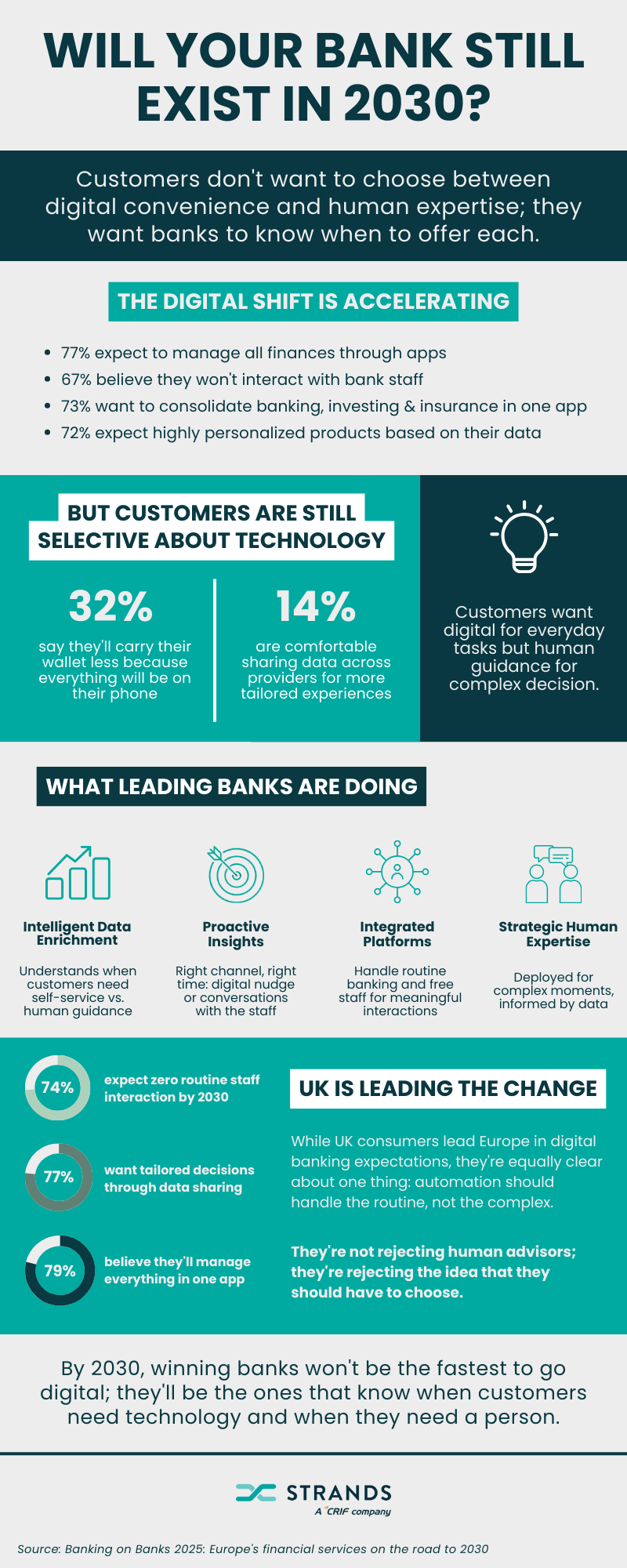
While most personal finance is already somewhat digital, consumers expect this to accelerate in the next few years. 67% of Europeans believe customers will no longer interact with bank staff by 2030, and three-quarters (77%) anticipate managing their entire financial lives through apps.
The writing on the wall is clear: traditional bank branches are no longer the default, with an increasing number of financial institutions moving to fully digital models. However, here’s what the data doesn’t reveal, and the opportunity that leading banks are seizing right now.
What do customers really want from digital banking in the next 5 years?
The same consumers demanding fully digital banking are surprisingly cautious about the technologies that could make it possible. While 32% of consumers say they’ll carry their wallet less because everything will be on their phone, only 18% expect to use AI assistants for financial product advice, and just 14% are comfortable sharing data across providers for more tailored experiences.
Even more revealing: 74% of consumers expect zero staff interaction by 2030, yet they’re equally clear about wanting human expertise available for complex decisions. Consumers don’t want to choose between digital convenience and human guidance; they want their bank to know when to offer each.
The message? Customers want digital tools for everyday banking, but they want human support for the moments that matter. The institutions that succeed will be those that use technology to determine when customers need self-service and when they need a real person.
How banks can balance digital convenience with human expertise
Most financial institutions see this data and rush to implement chatbots or to eliminate branches entirely, but they’re not focusing on the main challenge.
The future of digital banking experiences isn’t about replacing human judgment with algorithms. It’s about using AI data enrichment and predictive banking analytics to help banks understand customer behavior patterns and equip relationship managers with insights that inform when customers might benefit from proactive guidance.
Consider this: when a customer regularly checks their balance, categorizes spending, and even interacts with insights from their bank, that’s a signal they’re comfortable with digital self-service for everyday tasks. But when transaction patterns suddenly shift (e.g., a first home purchase, business expansion, or unexpected medical expenses), personalized banking insights surface these behavioral changes, enabling banks to proactively offer guidance when it’s most valuable.
What’s the secret to seamless digital banking with human touchpoints?
Personal Financial Management (PFM) and Business Financial Management (BFM) platforms are the infrastructure that enables multiple touchpoints between banks and customers.
While many banks have more passive PFM and BFM platforms, advanced solutions like Strands Lighthouse and Strands Compass use AI-driven behavioral analytics to do more than track spending. By analyzing transaction patterns and categorizing financial behaviors across dozens of attributes, our platforms empower advisors with enriched customer data and surface behavioral insights that help identify opportunities for timely interventions.
For example, when the platform detects changes in spending patterns or income stability, relationship managers can use these insights to determine whether to send a savings nudge or initiate a conversation about financial planning.
This aligns with the 72% of consumers who expect highly personalized products based on their shared data. They’re not asking for invasive tracking; they’re asking for their bank to understand their financial life well enough to be proactively helpful.
How can banks use AI without losing customer trust?
Here’s the key insight: 77% of consumers believe tailored, near-instant financial decisions will be available through greater data sharing by 2030, but they’re skeptical about AI assistants making decisions for them. What they want is predictive intelligence that empowers them to make better decisions themselves and human expertise (from banks) available when decisions get complex.
The winning formula:
- Intelligent data enrichment that reveals customer behavior patterns, helping banks anticipate when customers might benefit from self-service tools or personalized guidance.
- Proactive personalized banking insights delivered through the right channel at the right time, whether that’s a digital nudge or a conversation
- Integrated and proactive PFM/BFM experiences that handle routine banking seamlessly, freeing customers and staff to focus on more meaningful interactions
- Human expertise strategically deployed for complex moments, informed by data rather than replaced by it
By 2030, your bank might not have traditional branches. Your customers might handle most of their banking digitally. But the institutions that succeed won’t be the ones that went fully digital fastest; they’ll be the ones that made digital feel human and helpful.
The question isn’t whether your bank will still exist in 2030. It’s whether it will have become indispensable to your customers’ financial lives to the point that they are engaged and loyal to you.
At Strands, we’ve built our platform around AI-driven behavioral analytics and predictive insights that surface customer behavior patterns and financial indicators to banks. This intelligence equips relationship managers and digital teams with the context they need to deliver the right type of support, whether that’s enabling effective self-service tools or facilitating timely advisor conversations.